The World Behind the Novels · Biography
Alexandre Dumas: A Life in Words
The serialist who gave the world Musketeers and Monte Cristo — and whose shadow falls across every swashbuckling hero who followed.
Alexandre Dumas — born Dumas Davy de la Pailleterie on 24 July 1802 — became one of France's most prolific and widely translated authors. His serialized historical novels swept readers across Europe and beyond, and his output was staggering: over 100,000 published pages spanning novels, plays, travel writing, and journalism.
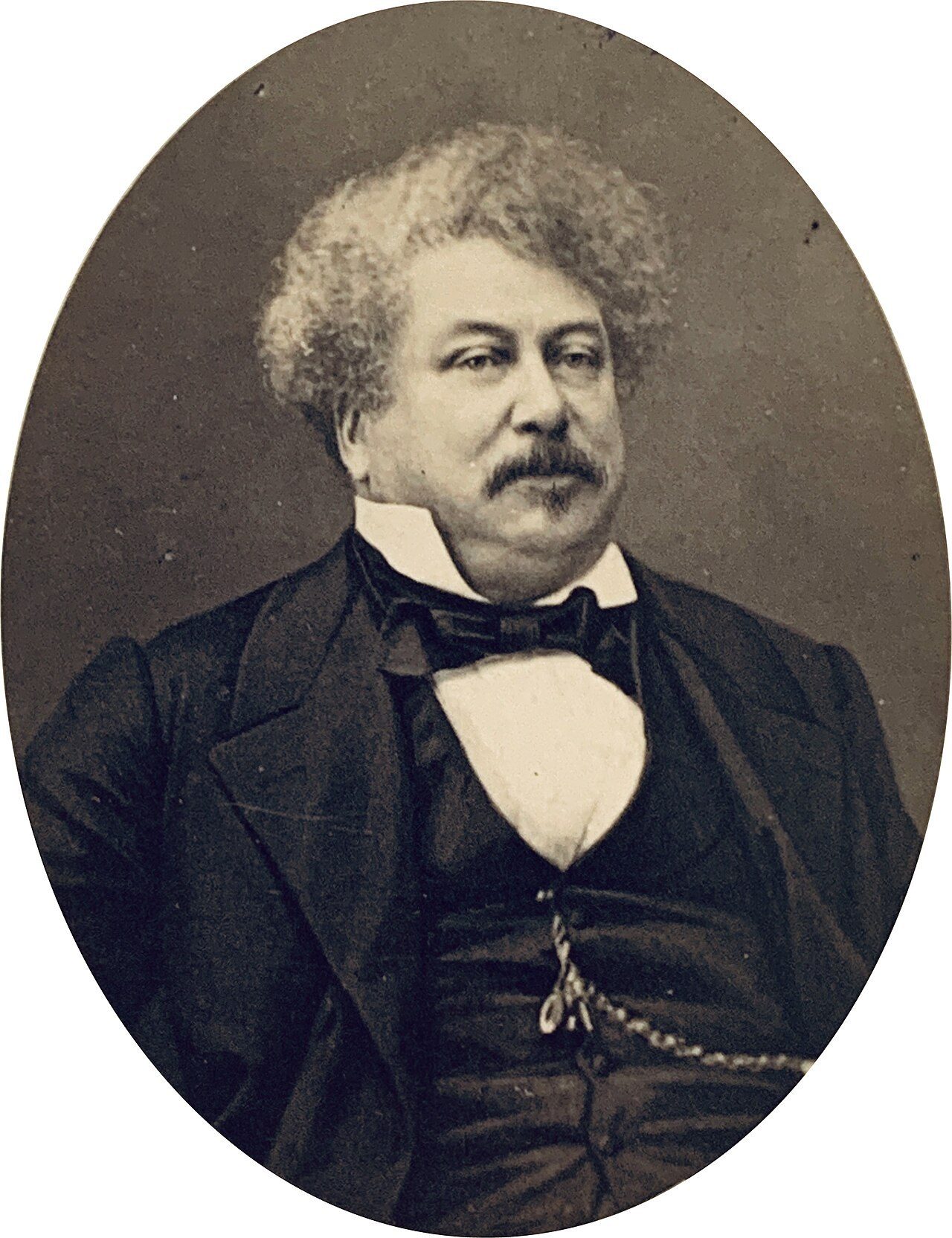
Alexandre Dumas
French novelist and playwright, 1802–1870
- 100,000+ pages published across all genres
- 200+ film adaptations of his work
- 8 volumes in Celebrated Crimes
From Stage to Serial
Dumas launched his career in theatre. His debut play, Henry III and His Courts, appeared in 1829 when he was 26 and was an immediate success. He later founded the Théâtre Historique ↗ in Paris ↗ in 1847, a stage dedicated to grand historical drama.
His novels arrived in serial form — The Three Musketeers, Twenty Years After, The Count of Monte Cristo, and The Vicomte de Bragelonne among them. He also collaborated with fencing master Augustin Grisier ↗ on The Fencing Master (1840), a novel so politically charged that Tsar Nicholas I ↗ banned it and barred Dumas from entering Russia until the Tsar's death.
Even unfinished, his work remained worth finishing — proof of a storytelling pull that outlasted the man himself.
- 1829Henry III and His Courts premieres — Dumas's theatrical breakthrough
- 1840The Fencing Master published; banned in Russia by Tsar Nicholas I
- 1844The Three Musketeers and The Count of Monte Cristo serialized
- 1846Château de Monte-Cristo built outside Paris; later sold to settle debts
- 1870Dumas dies at 68, mid-manuscript
- 2005The Knight of Sainte-Hermine published posthumously, completed by scholar Claude Schopp ↗
Fortune, Generosity, and Legacy
His novels made Dumas wealthy — and he spent freely. By 1846 he had built the extravagant Château de Monte-Cristo ↗ outside Paris, complete with a separate Gothic pavilion used as his writing retreat. His door was always open to visitors, acquaintances and strangers alike, and the money eventually ran out.
More than 200 films have been adapted from Dumas's work — a record that reflects not just his storytelling range but the universal pull of the worlds he created. He died in 1870 at 68, mid-manuscript. That final novel, The Knight of Sainte-Hermine, was completed over a century later by scholar Claude Schopp ↗ and published in 2005.
For readers of the Captain Alatriste series, Dumas stands as a direct ancestor: Arturo Pérez-Reverte ↗ has cited him openly as a model for serialized, morally serious adventure fiction rooted in real historical worlds.